Monday, December 15, 2014

Literature Review #1


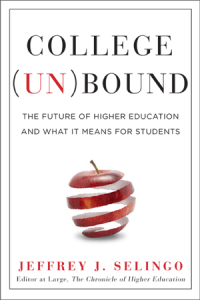
2. Selingo, Jeffrey J. College (un)bound: The Future of Higher Education and What It Means for Students. New York: New Harvest Houghton Mifflin Harcourt, 2013. Print.
3. This book discusses the worth of obtaining a college degree. Selingo offers insight into the devaluation of college degrees as a result of so many people attending college. He also suggests that students begin to search for alternative routes besides going to a traditional college in order to get a degree that it either more applicable to their future job or simply a degree that is cheaper. He discusses  vocation learning and online degrees as a result. Finally, he wonders and proposes what the future of education will be like in the United States. 
4. Qualifications: He has sold two best-selling books on this subject and he is a well known columnist and public speaker. His work's are acclaimed from people and groups ranging from the New York Times to the President of Cornell University. http://www.jeffselingo.com/about/
5. college for all- a phrase which means that everyone should go to college, regardless if they are financially or academically prepared/ suitable for college 
vocational education- an example of an alternative route to college which will allow partakers to gain real job experience in a field that they are going to be working in which allows them to be several years ahead in experience of college graduates, additionally, this method is less expensive and starts paying the student
6. "'Instead of subsidizing college for all, what if we created a national service program to take some unruly eighteen-year-olds and get real stuff done?"' (Selingo 166) -alternative roots to college or a way to prepare students before going to college to help them realize the importance of college
"'I always thought that the right thing to do was pursue a four year degree- there definately was pressure to do that... had no interest in whatever degree I was getting at Radford. Automotive technology was my best bet."' (Selingo 125)
"Right now, colleges have a corner on the credential market, and a credential is the ticket to most good jobs. That's why colleges can charge whatever they want for that piece of paper." (Selingo 68)
7. In short, these quotes illustrate the fact that college tuition rates are rising because of the ideology that one has to go to college in order to be successful. Therefore, as government funding decreases and tuition rate rise so too must privatization grow. These quotes also show the importance of becoming educated in a field that interests the student and is applicable to the job that they are going to be doing. There is no sense in paying for a degree that you do not like, cannot use, and accruing massive debt. Selingo offers alternative ideas to college that would be more prevalent if we this country saw education as more of a communal issue. He highlights votechs and programs designed to help students gain perspective. Both of which prepare students for their future and help them determine if they really need or should go to college. 

Sunday, December 14, 2014

Blog Post #9

My argument is that death of imagined community in the USA has caused privatization to come into an ever increasing state of being which coupled with the college for all movement has resulted in colleges raising tuition at astronomical rates due to the high demand for an education, which has resulted in devaluing degrees and an educational bubble. This part of my argument is most applicable to the counter argument posed by President Obama in his State of the Union Address as recorded in Selingo's College (Un)Bound on page 70. The president blames the above issue on institutions taking advantage of federal funds and the states' lack of control over higher education in order to create these high tuition rates. He decides that college for all is not the problem, the schools are. He then ends this quote by threatening to cut all funding to schools which are unable to control themselves, in order to reduced tuition. In this way the president is trying to create a community which demands that one part of the community not exploit the other for its own gain.  Ultimately, the president sees the problem as the result of individualism but he blames privatization/rising tuition on schools which are making it impossible for the government to adequately fund them, instead of on an outdated ideology and a specifically a shattered community.

Selingo, Jeffrey J. College (un)bound: The Future of Higher Education and What It Means for Students. New York: New Harvest Houghton Mifflin Harcourt, 2013. Print. 

Blog Post #8

I decided to interview my old german friend, Ariane Berger who lives in Germany and who is currently attending the Goethe-Universitaet Frankfurt am Main. Although she is not an academic source. She does have the keen insight that my paper requires in terms of imagined community and the multi-tiered system as a result. She unlike an American professor can speak from experience rather than theory on the aforementioned subjects. The questions and answer are shortened because the interview was conducted in German and notes were kept simple:
- Explain the goal of the German system?
         different exams decide which tracks students shall go on, "Someone needs to invent the machine, someone needs to repair the machine, and someone needs to operate the machine." which is particularly interesting to/ useful for my case because it speaks exactly to my point of the ability of the multi-tiered German system to produce people who are capable of serving the needs of the community rather than their individual needs
- How does Germany prevent privatization? How does not having to pay tuition make people feel?
         privatization is prevented by high tax rates which help to pay for college, thus making it free which relieves a lot of stress because debt is not building up on students while they are in college which allows them to better focus on school
- How would you compare the German system to the American system of higher education?
        Essentially, she said that the German system is based in rationality while the American system is based in craziness. She wanted to know why colleges here are so expensive and how the government could let this happen?
- Can you speak to the quality of education for students?
 In summary, a person gets an education which is equal to the type of work that person is going to, most likely, be spending their life preforming. She also noted that this system tends to cause inequality because it is very difficult for people to rise to a higher track but it is easier to go down a track. She also fears that this system can cause those with lesser primary and secondary schooling to become unfairly trapped or forced to pursue a lower education track, thus preventing them from earning the degree they deserve. This is an interesting counterpoint to my argument. It is a negative. However, this negative also exists in the United States, although not as formally as in Germany. (See Intro. to Education curriculum)

Blog Post #7

The dissolution of the imagined community which formed in the United States during the post-World War II era has caused privatization to return and gain an ever increasing role in society. Privatization of higher education will be the focus of this paper. Privatization in the United States will be compared to Germany because Germany has managed to maintain its sense of community. Thus, Germans continue to enjoy free higher education. Additionally, the multi-tiered education system has prevented the negative effects of increased government education goals, such as the college for all movement in the United States. The college for all movement in the United States has not only worsened the effects of privatization but it has caused many student accrue massive personal debt, a devaluated degree, and for a higher education bubble to form. The German system is capable of preventing this because of the aforementioned tiered system which sets quotas for each level of education thus preventing the society from producing too many college graduates and not enough, say, manufactory workers.
In order to support these claims I plan on using College Unbound by Jeffrey Selingo, Imagined Communities by Benedict Anderson, and The Higher Education Bubble by Glenn Reynolds to form the center of my argument. Academic sources such as by Jamshidi and Breinig will fill in the gaps in my theories. I still need to find a better expert on the German education system. Perhaps my interview with my German friend this week will be able to assist me. I need to be able to show: increased enrollment,rising tuition rates, accumulation of debt, devaluating degrees, the concept of an educational bubble (like the housing bubble), and to be able to successfully tie in the German education system.

Blog Post #10

https://docs.google.com/document/d/1Cgqbj1TgLl9IhdmJXK-cN7Q4vR-ukj5QcM6UNZ6GUoE/edit - please note that the google doc which contains my final paper has been shared with you via google docs, thank you

Abstract: This paper will establish how the long term failure of the United States of America to maintain an imagined community, as outlined by Benedict Anderson in Imagined Communities: Reflections on the Origin and Spread of Nationalism, which focuses on the betterment of society not the individual has resulted in a reversion to American rugged individualism and privatization in higher education. This coupled with the state ideology of “college for all” has resulted in a dramatic rise in the price of college tuition due to decreased federal aid and an increased reliance on the private sector to fund education. This has with rise in college enrollment helped to devaluate college degrees and create an educational bubble. This bubble is much like the housing bubble. Finally, the American “community” and system it has created will be juxtaposed to the multi-tiered German education system and its success due to its focus on community. 
 Work Cited
Anderson, Benedict R. O'G. Imagined Communities: Reflections on the Origin and Spread of Nationalism. London: Verso, 1991. Print.
Bennett, Daniel L. "Chart of the Week: College Enrollment Growth." Web log post. The Center for College Affordability and Productivity. N.p., 5 Jan. 2011. Web. 12 Dec. 2014. <http://collegeaffordability.blogspot.com/2011/01/charts-of-week-college-enrollment.html>.
Breinig, Helmbrecht, Jürgen Gebhardt, and Berndt Ostendorf. German and American Higher Education: Educational Philosophies and Political Systems. Münster: Lit, 2001. Print.
Geoghegen, Thomas. "New Labor." Interview by Brian Lehrer. The Brian Lehrer Show. BBC World Service. WNYC 93.9 FM, New York, New York, 2 Dec. 2014. Radio.
Hummelsheim, Stefan1, Stefan.Hummelsheim@giz.de, and Michaela2, Michaela.Baur@giz.de Baur. "The German Dual System Of Initial Vocational Education And Training And Its Potential For Transfer To Asia." Prospects (00331538) 44.2 (2014): 279-296.Education Full Text (H.W. Wilson). Web. 21 Oct. 2014.
Iannone, Carol. Bubble Trouble. 26 Aug. 2011. EDITOR’S INTRODUCTION TO THIS ISSUE. Springer Science+Business Media, LLC 2011.
Jamshidi, Laleh1, laleh.jamshidi@yahoo.com, et al. "Developmental Patterns Of Privatization In Higher Education: A Comparative Study." Higher Education 64.6 (2012): 789-803. Education Full Text (H.W. Wilson). Web. 21 Oct. 2014.
Lomawaima, K. Tsianina, and Teresa L. McCarty. "Chapter 1: Choice and Self-Determination: Central Lessons From American Indian Education." To Remain an Indian. New York: Teacher's College, 2006. 1-42. Print.
Menashy, Francine. "Theorizing Privatization In Education: Comparing Conceptual Frameworks And The Value Of The Capability Approach." Current Issues In Comparative Education 16.1 (2013): 13-25. ERIC. Web. 21 Oct. 2014.
Meneghello, Aurora. “Default: The Student Loan Documentary.”  Online video.  YouTube.  16 Feb 2013.  Web. http://www.youtube.com/watch?v=wvQR93C6n2E  OR  http://vimeo.com/14215806
http://www.defaultmovie.com/
Perry, Mark J. "Carpe Diem: Higher Education Bubble: College Tuition Doubled Over the Last 10 Years vs. +52% for Medical Care." Web log post. CARPE DIEM. Mark J Perry, 22 July 2011. Web. 14 Dec. 2014.
Reynolds, Glenn H. The Higher Education Bubble. New York: Encounter, 2012. http://mjperry.blogspot.com/2011/07/higher-education-bubble-college-tuition.html
Reynolds, Glenn Harlan (2012-06-26). The Higher Education Bubble (Encounter Broadside) (Kindle Location 22). Encounter Books. Kindle Edition.
Selingo, Jeffrey J. College (un)bound: The Future of Higher Education and What It Means for Students. New York: New Harvest Houghton Mifflin Harcourt, 2013. Print.

Blog Post #6


Perry, Mark J. "Carpe Diem: Higher Education Bubble: College Tuition Doubled Over the Last 10 Years vs. +52% for Medical Care." Web log post. CARPE DIEM. Mark J Perry, 22 July 2011. Web. 14 Dec. 2014. 

This image will be used to graphically depict the steep rise in the cost of education. It will demonstrate that the rate of inflation for tuition is much greater than many other sectors. This increase is unjustified. The market cannot support such an increase. Ultimately, this will show the detrimental effects of privatization on higher education. Not only are schools more expensive due to high demand to attend them but now students must receive ever larger loans in order to pay for an education that is rapidly becoming to expensive. The price does not match the reward. 
Additionally, it matches well with Reynolds' argument about the higher education bubble but I will go into further detail about that subject during the essay. 

Blog Post #5

Work Cited
Anderson, Benedict R. O'G. Imagined Communities: Reflections on the Origin and Spread of Nationalism. London: Verso, 1991. Print.
Bennett, Daniel L. "Chart of the Week: College Enrollment Growth." Web log post. The Center for College Affordability and Productivity. N.p., 5 Jan. 2011. Web. 12 Dec. 2014. <http://collegeaffordability.blogspot.com/2011/01/charts-of-week-college-enrollment.html>.
Breinig, Helmbrecht, Jürgen Gebhardt, and Berndt Ostendorf. German and American Higher Education: Educational Philosophies and Political Systems. Münster: Lit, 2001. Print.
Geoghegen, Thomas. "New Labor." Interview by Brian Lehrer. The Brian Lehrer Show. BBC World Service. WNYC 93.9 FM, New York, New York, 2 Dec. 2014. Radio.
Hummelsheim, Stefan1, Stefan.Hummelsheim@giz.de, and Michaela2, Michaela.Baur@giz.de Baur. "The German Dual System Of Initial Vocational Education And Training And Its Potential For Transfer To Asia." Prospects (00331538) 44.2 (2014): 279-296.Education Full Text (H.W. Wilson). Web. 21 Oct. 2014.
Iannone, Carol. Bubble Trouble. 26 Aug. 2011. EDITOR’S INTRODUCTION TO THIS ISSUE. Springer Science+Business Media, LLC 2011.
Jamshidi, Laleh1, laleh.jamshidi@yahoo.com, et al. "Developmental Patterns Of Privatization In Higher Education: A Comparative Study." Higher Education 64.6 (2012): 789-803. Education Full Text (H.W. Wilson). Web. 21 Oct. 2014.
Lomawaima, K. Tsianina, and Teresa L. McCarty. "Chapter 1: Choice and Self-Determination: Central Lessons From American Indian Education." To Remain an Indian. New York: Teacher's College, 2006. 1-42. Print.
Menashy, Francine. "Theorizing Privatization In Education: Comparing Conceptual Frameworks And The Value Of The Capability Approach." Current Issues In Comparative Education 16.1 (2013): 13-25. ERIC. Web. 21 Oct. 2014.
Meneghello, Aurora. “Default: The Student Loan Documentary.”  Online video.  YouTube.  16 Feb 2013.  Web. http://www.youtube.com/watch?v=wvQR93C6n2E  OR  http://vimeo.com/14215806
http://www.defaultmovie.com/
Perry, Mark J. "Carpe Diem: Higher Education Bubble: College Tuition Doubled Over the Last 10 Years vs. +52% for Medical Care." Web log post. CARPE DIEM. Mark J Perry, 22 July 2011. Web. 14 Dec. 2014.
Reynolds, Glenn H. The Higher Education Bubble. New York: Encounter, 2012. http://mjperry.blogspot.com/2011/07/higher-education-bubble-college-tuition.html
Reynolds, Glenn Harlan (2012-06-26). The Higher Education Bubble (Encounter Broadside) (Kindle Location 22). Encounter Books. Kindle Edition.

Selingo, Jeffrey J. College (un)bound: The Future of Higher Education and What It Means for Students. New York: New Harvest Houghton Mifflin Harcourt, 2013. Print.